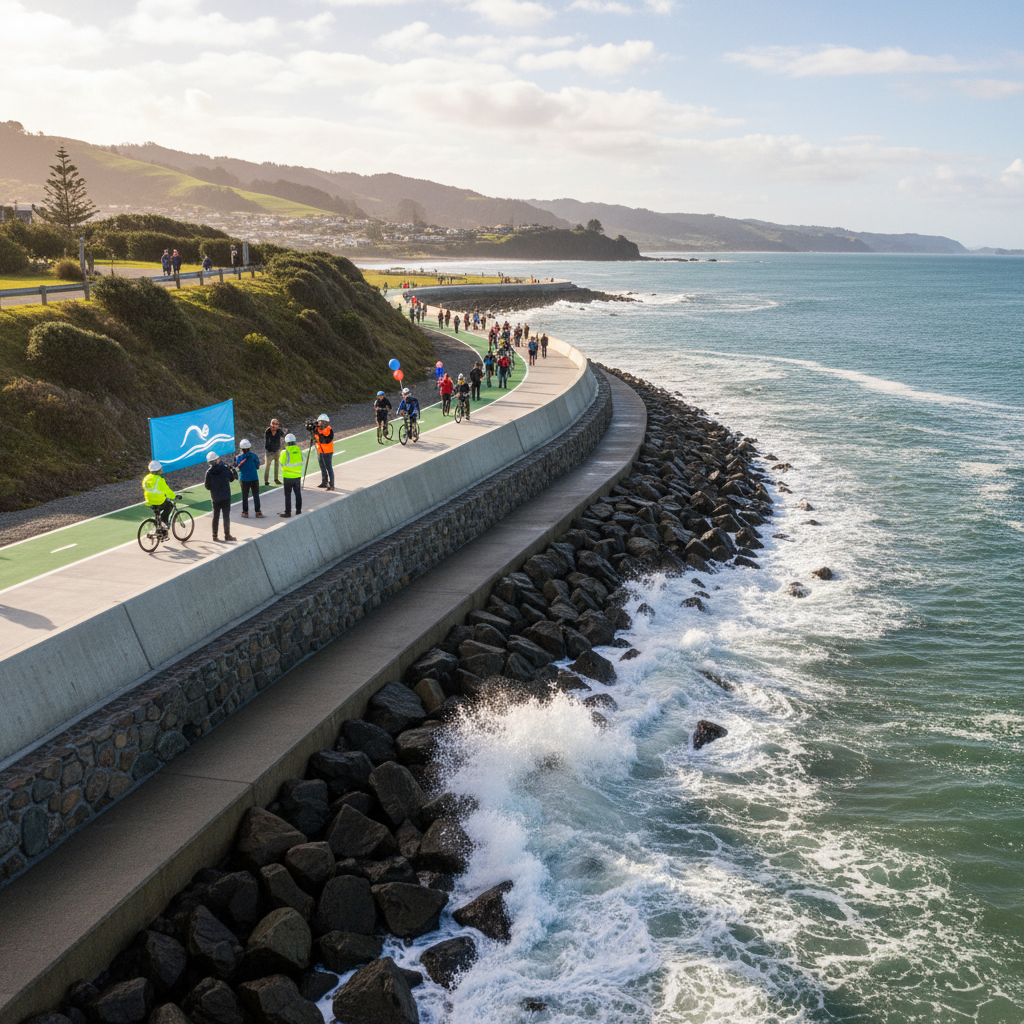
Lower Hutt’s new Eastern Bays Shared Path was officially opened this morning, marking the completion of a multi-year, $81.9 million project designed to improve transport resilience and create safer walking and cycling connections for residents.
The 4.4-kilometre path and accompanying seawall runs along Marine Drive, connecting Point Howard to Eastbourne. Transport Minister Chris Bishop, speaking at the opening, hailed the project as a significant investment in the region's infrastructure. He emphasised its dual role in both protecting the vital coastal route from weather events and promoting active travel.
A long-awaited connection
For the thousands of residents in Lower Hutt's Eastern Bays, Marine Drive is a lifeline. The road is the primary access route to and from the rest of the Hutt Valley and Wellington, making its reliability essential. Historically, this stretch of coast has been vulnerable to storm surges and erosion, which has posed an ongoing risk to the road surface and the major wastewater pipe for the Hutt Valley located beneath it.
This project strengthens a critical coastal route that Eastern Bays communities rely on, helping protect Marine Drive from waves and erosion, as well as extreme weather events. The seawall also protects critical infrastructure under the road, including a major wastewater discharge pipe serving the Hutt Valley – making this a value-for-money investment in the services people depend on.
The new engineered seawall is designed to absorb and deflect wave energy, significantly reducing the risk of damage and closures during severe weather. According to the government, this proactive investment is crucial for safeguarding the community and its essential services against the growing impacts of climate change and sea-level rise, a major concern for coastal areas across New Zealand. The project's total cost of $81.9 million was financed through a combination of government funds, with $30 million from the National Infrastructure Fund for an Improved Network (NIFF), $25.5 million from NZTA (Waka Kotahi), and the remaining $26.4 million from Hutt City Council.
This level of investment reflects the high priority placed on securing critical infrastructure in what some commentators have described as a NSW government's significant renewable deal, where ensuring the long-term viability of public assets is paramount.
New opportunities for active travel
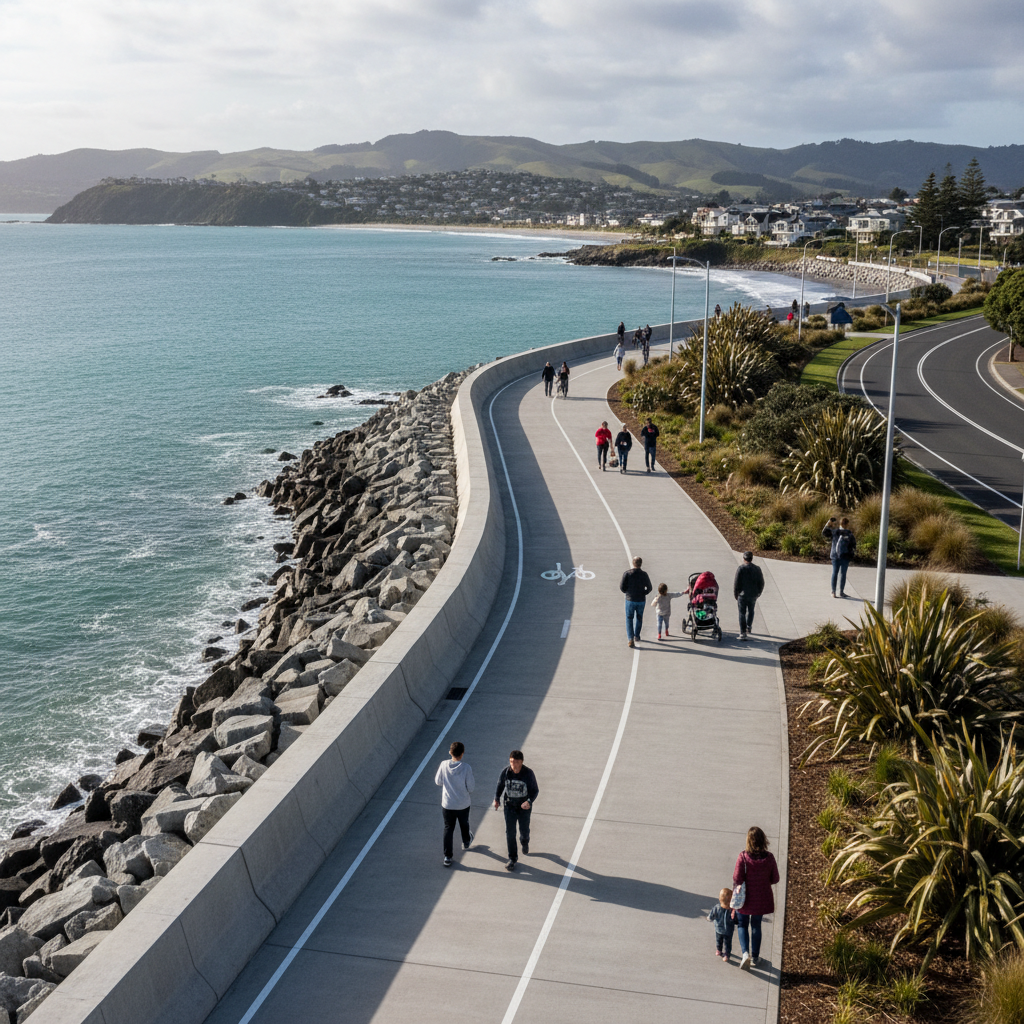
Beyond its defensive capabilities, the project delivers a major upgrade for pedestrians and cyclists. The wide, separated path offers a safe and scenic route for commuting and recreation, connecting the various bays and linking into the wider Hutt Valley transport network. It sits alongside the nearby Ngauranga to Petone Shared Path, together forming a significant continuous route for active transport users.
Mr Bishop says the path creates a "safer, more attractive walking and cycling connection" that supports active travel and helps reduce traffic congestion. This aligns with a broader national and local focus on providing viable transport alternatives to private vehicles. The new path not only benefits commuters heading towards the Petone community hub and beyond but also enhances the area as a destination for recreation, promoting healthy lifestyles and local tourism.
Civic projects that encourage cycling and walking have become increasingly popular, mirroring a global trend. Similar large-scale projects, such as the district ride centre currently under construction in Ocean Grove, Australia, highlight the strong community demand for high-quality recreational facilities. That project has faced challenges with eager riders attempting to use the tracks before completion, demonstrating the high level of public anticipation these developments can generate.
A journey of patience and partnership
The path to completion has been a long one, a fact acknowledged by the Transport Minister. The project’s origins trace back to early community engagement in 2015, with consent approvals secured between 2019 and 2021 before construction finally commenced in August 2022. The work was delivered in stages across the Eastern Bays to minimise disruption, with sections opening progressively as they were finished.
Key milestones included the opening of the Eastbourne to Days Bay section in November 2023, the completion of Sunshine Bay and York Bay by December 2024, and the final works in Lowry Bay finishing this month. "I want to acknowledge the patience of Eastern Bays communities during construction," Mr Bishop says. "It’s taken a while, but the Bays are now more resilient, and this long-awaited piece of infrastructure is now done."
The project was delivered by the Te Ara Tupua Alliance, which includes NZTA, Downer NZ, HEB Construction, and Tonkin + Taylor. A crucial element of the project's framework was the partnership with iwi mana whenua, Taranaki Whānui ki te Upoko o te Ika and Ngāti Toa Rangatira, who were involved through a Mana Whenua Steering Group alongside Hutt City Council. This collaborative approach reflects a modern standard for major public works, ensuring that cultural and historical heritage is respected and integrated into the development of new community assets.
Looking ahead, the successful completion of the Eastern Bays Shared Path serves as both a practical solution to urgent environmental challenges and a community-focused amenity that will be enjoyed for decades to come. As noted by agencies like NIWA, such forward-thinking infrastructure is vital for New Zealand's coastal communities to adapt to a changing environment.